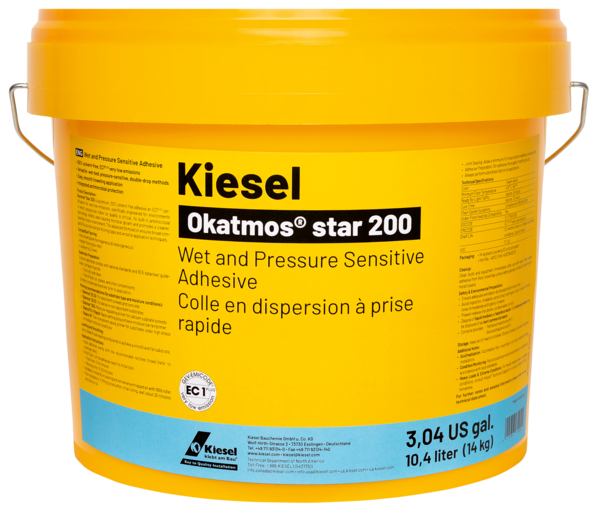


Okatmos® star 200
Wet- and Pressure Sensitive Adhesive
- 100 % solvent free, EC1 Plus very low emission formulation—ideal for projects demanding superior indoor air quality
- Different application modes: wet bed, pressure sensitive, or contact bond (double drop) for maximum job site flexibility
- Smooth, effortless troweling with excellent workability
- Integrated antimicrobial protection that suppresses odor causing microbes at the adhesive interface
- Broad material compatibility: homogeneous & heterogeneous vinyl, LVT, rubber (≤ 4 mm / 5/32 in.), linoleum (≤ 3.2 mm / 1/8 in.) and most textile backings
- Low-Emission Certified: EMICODE EC 1Plus classification ensures very low VOC emissions,
- supporting healthy indoor air quality
- Enhanced with Kiesel Breathe Easy Technology and anti-microbial protection
- VOC - 11.7 g/l
100 % solvent‑free, EC1‑PLUS very‑low‑emission adhesive for projects where indoor‑air quality is critical.
- Wide compatibility:
- Vinyl sheet and plank (homogeneous & heterogeneous)
- Rubber flooring ≤ 4 mm
- Linoleum ≤ 3.2 mm
- Textile floorings with PVC‑, latex‑, or PUR‑backing
- Flexible application: traditional semi-wet‑bed, pressure‑sensitive or double‑drop contact bonding.
- Hygienising formulation inhibits microbial growth within the adhesive layer, preventing odors from developing between the flooring and the substrate.
All substrates must meet the requirements of VOB Part C, DIN 18 365 and relevant local installation standards.
Substrates must be clean, flat, dry, structurally sound, and free from dust, oil, grease, waxes, curing compounds, sealers, paint, and any other bond-inhibiting residues.
Surface irregularities, including cracks, holes, high spots, or uneven transitions, must be corrected using a cement-based, polymer-modified patching or leveling compound, applied per the manufacturer’s instructions.
For highly absorbent substrates, apply a primer such as Okatmos® UG 30, Okatmos® DSG, Okatmos® EG 20, Okamul PU‑V Rapid or Okapox GF first (refer to each product's datasheet for detailed instructions). Priming is essential to control porosity and prevent the adhesive from being absorbed too quickly. Do not apply adhesive directly over the primer. Instead, cover the primed surface with a patching or self-leveling compound, using the thickness specified in the relevant product datasheet.
When installing over vapor‑tight coverings, build up the levelling compound to the minimum thickness specified in the compound’s datasheet to ensure reliable adhesion and moisture management. Following these steps will provide an ideal, load‑bearing surface for subsequent adhesive application and floor‑covering installation
Moisture levels must be tested and documented prior to installation. Acceptable levels are:
≤ 10 lbs/1000 ft²/24 hrs (per ASTM F1869 – Calcium Chloride Test)
≤ 90% RH (per ASTM F2170 – In-situ RH Test)
Maintain a consistent ambient temperature of +17°C to +30°C (63°F to 85°F) and relative humidity between 30–50% before, during, and after installation.
- Apply adhesive with the specified notched trowel (see Coverage table) in a uniform layer.
- Allow the adhesive to reach its initial tack (working time varies by method).
- Lay the covering, allowing entrapped air to off‑gas; roll and rub down firmly across the entire surface.
- If the covering lifts after rolling, wait about 30 minutes, then re‑roll.
- Wait at least 24 hours before welding or sealing joints.
- Separation is unlikely, but if any settling is visible, stir until no streaks remain.
Color
Cream white
Minimum floor temperature
+15 °C / 59 °F
Flash-off time*
After approx. 5 - 40 minutes
Open time (working)
After approx. 5 – 120 min
Loadable*
Ready for light traffic after approx. 24 hours
After approx. 72 hours
Chair caster suitability
Suitable
Compatible
D 1 according to TRGS 610
EMICODE®
EC 1Plus (very low emission)
11,7 g/L
12 months (store in a climate-controlled facility)
*
At 68 °F (+20 °C) and 65 % relative humidity. Higher temperature and low humidity decreases, lower temperature and high humidity increases this value respectively.
- Acclimatise all floor coverings to on‑site temperature and humidity before installation.
- Record substrate moisture and ambient temperature/relative‑humidity readings in accordance with local standards before you begin.
- For areas exposed to heavy mechanical loads or extreme temperatures, switch to Okamul PU or consult Kiesel Technical Support for a suitable alternative.
| Trowel type | Coverage per (g/m²) | Coverage per 3.14 gal (m²) | Coverage per 3.14 gal (ft²) |
|---|---|---|---|
| CS-9 No. 25 Canadian | 340 | 45 | 489 |
German TKB A2 Approx.: ³⁄₆₄" × ¹⁄₁₆" × ³⁄₆₄"
| 250–300 | 51–61 | 550–660 |
German TKB A5 Approx.: 3/64" × 3/64" × 1/32"
| 200–250 | 61–77 | 665–830 |
German TKB B1 Approx: ⁵⁄₆₄" × ³⁄₃₂" × ³⁄₃₂"
| 300–350 | 44–51 | 475–554 |
Actual consumption depends on substrate texture, levelling compound, and application method.
Clean‑up: remove adhesive residues from tools and equipment with water immediately after use. Wipe any excessive adhesive off floor covering with damp sponge.
| Description | Item No. | |
|---|---|---|
| 14 kg/ 3.14 U.S. gal/ 11.9 Liters plastic bucket | 80919 | |
| 6 kg/ 1.35 U.S. gal/ 5.10 Liters plastic bucket | 80605 |
- Ventilation: Even though the product’s VOC emissions are very low, keep the work area well‑ventilated during application and curing.
- Personal protection: Avoid ingestion, inhalation, and contact with eyes or skin. If contact occurs, rinse immediately with clean water.
- Environmental protection: Do not allow the product to enter drains, surface water, or soil.
- Disposal:
Liquid residues → dispose of as hazardous waste. - Fully‑hardened residues → dispose of as inert commercial waste.
- Biocide content: Contains methylisothiazolinone (MIT) and benzisothiazolinone (BIT). Allergy information: +49 711 93134‑0.
- Storage: Keep out of reach of children.
The aforementioned information, especially the proposals for processing and utilizing our product, is based on our knowledge and experience. We recommend that you carry out your own tests in every case to ensure the suitability of our products for the intended process and processing purposes because of the different materials and the working conditions which lie beyond our area of influence. No liability can be derived from this advice or from verbal advice, unless we are responsible for (criminal) intent or gross negligence in this respect.

Coverage calculator imperial
Coverage calculator metric
Calculate quickly and easily